
Latest Posts
- How GLP-1 Medications Help People Build Healthier Long-Term Eating Habits

- Why Doctors Are Increasingly Recommending GLP-1 Medications for Type 2 Diabetes

- The Biggest Myths About Placebo Groups in Clinical Trials

- How to Protect Your Joints So They Last a Lifetime
- The Connection Between Physical Health and Mental Wellbeing

Categories
Archive
Falls are the leading cause of injury-related death among adults over 65, and the statistics behind that fact are significant enough to warrant more serious attention than most people give them before a fall has already happened. One in four adults over 65 falls each year in the United States. Falls are the most common cause of traumatic brain injury and hip fracture in older adults. Hip fractures specifically carry a one-year mortality rate of approximately 20 to 30 percent in older adults, and many who survive them never fully regain their previous level of independence and mobility.
These numbers are not intended to frighten. They are intended to convey the genuine stakes of a problem that is both common and largely preventable. The most consistently supported intervention for fall prevention in older adults is balance and strength training, and the research behind it is clear enough that most major geriatric medicine organizations recommend it as a primary prevention strategy for anyone over 65.
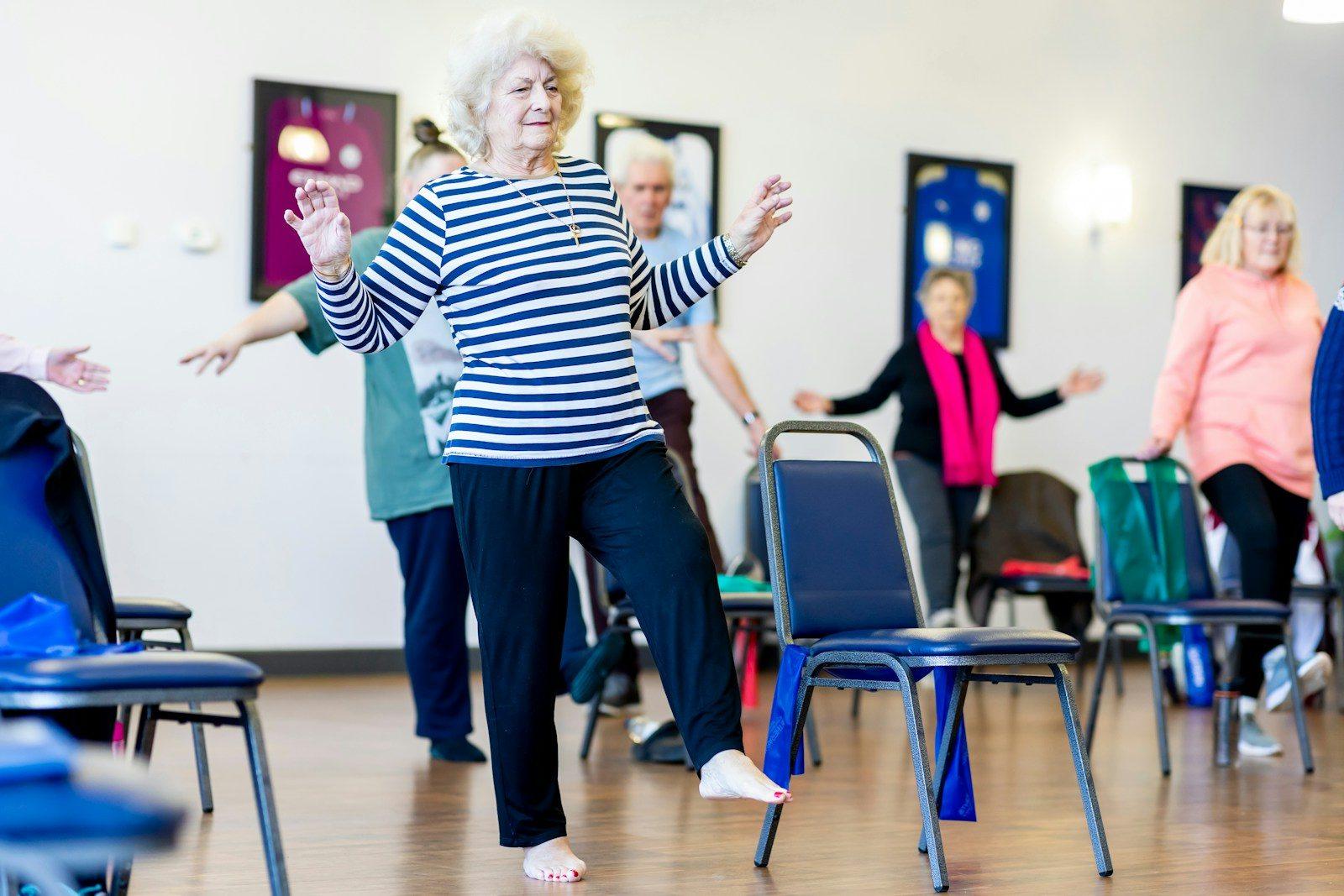
Balance is not a fixed trait that either holds or fails with age. It is a capacity that responds to training in the same way that strength and cardiovascular fitness respond to training. Older adults who practice balance exercises consistently improve their balance measurably, reduce their fall risk significantly, and maintain the physical confidence and independence that falls threaten. The exercises required to achieve these outcomes are not intense, complicated, or time-consuming. They are accessible, gentle, and deliverable in fifteen to twenty minutes several times per week.
Why Balance Declines With Age and What Can Be Done
Balance depends on the integration of three sensory systems. The vestibular system in the inner ear detects head position and movement. The visual system provides information about the surrounding environment and the body’s position within it. The proprioceptive system, consisting of sensory receptors in the muscles, joints, and skin, provides information about the body’s position in space without visual input. The brain integrates these three streams of information continuously and makes rapid adjustments to muscle activation that maintain upright posture and prevent falls.
All three systems decline in sensitivity and reliability with age. Vestibular function decreases, reducing the accuracy of balance signals from the inner ear. Visual acuity and depth perception decrease, reducing the quality of environmental information the balance system uses. Proprioception declines, making the body less accurate at detecting its own position and making the rapid postural adjustments that prevent a stumble from becoming a fall.
Alongside these sensory changes, the muscle strength and reaction speed required to execute balance corrections also decline. Sarcopenia, the age-related loss of muscle mass, reduces the force available for rapid postural responses. Reaction time slows, meaning the corrective response to a perturbation takes longer to execute. The combination of reduced sensory input and reduced corrective capacity is what makes falls more likely despite the person feeling no different subjectively than they did in younger years.
Balance training works by challenging the balance system in ways that force it to adapt and improve. Repeatedly exposing the system to controlled balance challenges strengthens the neural pathways involved in postural control, improves the speed and accuracy of balance corrections, builds the proprioceptive sensitivity that provides the earliest warning of balance disruption, and develops the muscle strength that executes corrective responses effectively. The improvement is genuine and measurable, and it transfers directly to real-world fall risk reduction.
The Exercises Worth Practicing Regularly
The exercises below are organized from less to more challenging. Begin with the earliest exercises in the progression and advance only when you can perform the current level comfortably and with confidence. Using a sturdy chair, kitchen counter, or wall for support where indicated is not a concession to weakness. It is appropriate safety practice that allows the exercises to be performed with enough confidence to produce genuine balance challenge without risking an actual fall during training.
Single leg stance. Stand behind a sturdy chair with both hands lightly resting on the back. Lift one foot slightly off the floor and maintain the position for ten seconds. Return the foot to the floor and repeat on the other side. Perform five repetitions on each side. As this becomes comfortable, progress to holding for twenty seconds, then thirty. Then progress to using one hand on the chair, then fingertip contact only, then no contact. Finally, when confident without support, close the eyes briefly during the hold, which removes visual input and significantly challenges the vestibular and proprioceptive systems.
Single leg stance is the foundational balance exercise because it directly trains the capacity that falls most commonly compromise. Walking, stair-climbing, and most daily activities involve brief periods of single-leg support, and the ability to maintain balance during those moments is what prevents a stumble from becoming a fall.
Heel-to-toe walk. Stand near a wall or counter for support if needed. Place one foot directly in front of the other so that the heel of the front foot touches or nearly touches the toes of the back foot. Walk forward in this tandem fashion for ten steps, then turn carefully and walk back. Repeat three to four times. This exercise challenges balance in the lateral direction, which is the direction most relevant for preventing the sideways falls that produce hip fractures.
Progress this exercise by performing it without wall support when confidence allows, then along a straight line on the floor, and eventually with the eyes closed briefly during the walk to remove visual input.
Weight shifting. Stand with feet hip-width apart beside a chair or counter. Shift your weight slowly onto the right foot, lifting the left foot just slightly off the floor, then shift back through center to the left foot. Perform this rhythmic weight transfer ten times in each direction. Weight shifting trains the lateral balance response and develops the hip abductor strength that stabilizes the pelvis during single-leg support.
Progress this exercise by increasing the height of the foot lift during the weight transfer, by performing it on a slightly unstable surface such as a folded towel or balance cushion when available, and by increasing the speed of the transfers gradually.
Sit to stand. Begin seated in a chair at a height that allows the feet to rest flat on the floor with the knees at approximately ninety degrees. Without using the arms for assistance if possible, lean slightly forward and stand up to a fully upright position, then lower back down to seated in a controlled manner. Perform ten repetitions. If unable to perform without arm assistance initially, use the arms to help and gradually reduce the assistance as leg strength improves.
Sit to stand trains the quadriceps, gluteal muscles, and hip extensors that are essential for the rapid force production balance corrections require. It also directly practices one of the movement patterns that falls most commonly occur during and around, the transition between seated and standing positions.
Calf raises. Stand behind a chair with both hands lightly resting on the back for balance. Rise up onto the toes of both feet as high as comfortable, hold briefly, then lower back down. Perform fifteen to twenty repetitions. Progress to single-leg calf raises when bilateral raises are comfortable.
Calf raises build the lower leg strength that provides the fine balance adjustments that upright stance requires and strengthens the ankle plantar flexors that push off during walking. Ankle weakness is a frequently overlooked contributor to fall risk that calf raises address directly.
Backward walking. With a clear space behind you and a wall or counter within reach for safety, take ten slow, deliberate steps backward. Turn carefully and repeat. Backward walking challenges the balance system in a different direction than forward walking, develops the proprioceptive awareness of foot placement, and trains the postural adjustments required when moving in directions the visual system is not oriented toward.
Step-ups. Using a bottom stair step with a handrail for safety, step up onto the step with the right foot, bring the left foot up, then step back down leading with the right foot. Perform ten repetitions leading with the right foot, then ten leading with the left. Step-ups build single-leg strength and balance simultaneously and directly train the movement most relevant to stair safety, which is one of the most common locations for falls in the home.
Tai Chi as a Comprehensive Balance Practice
Tai chi deserves specific mention as a balance training modality because the research supporting it for fall prevention is among the strongest available for any single intervention. Multiple systematic reviews and meta-analyses have found that tai chi reduces fall frequency in older adults by 20 to 45 percent across different study populations and intervention durations. This effect size is comparable to or exceeds that of other fall prevention programs and is achieved through a practice that is enjoyable, social, and accessible to people with a wide range of functional capacity.
The balance benefits of tai chi come from its emphasis on slow, controlled weight shifting, single-leg balance maintenance, awareness of body position, and the coordination of movement with breath in ways that develop proprioceptive sensitivity alongside muscle strength and neuromuscular control. The meditative quality of the practice reduces the movement anxiety that many older adults develop after a fall or near-fall, which is itself a significant fall risk factor because anxious, tentative movement patterns are less stable than confident, fluid ones.
Community tai chi classes are widely available through senior centers, community recreation programs, and health systems, and the social dimension of group practice adds a motivation and consistency benefit that home-based individual exercise sometimes lacks.
Addressing the Environmental Component
Balance training reduces fall risk from within the body. Reducing fall hazards in the environment addresses the external contribution to falls that no amount of balance training fully eliminates. Both approaches together produce better outcomes than either alone.
The most common environmental fall hazards in the home include loose rugs and floor coverings that catch feet or shift underfoot, poor lighting particularly on stairs and in hallways between bedroom and bathroom, absence of grab bars in bathrooms where wet surfaces and position changes create specific fall risk, and clutter that creates obstacles in frequently navigated paths. Addressing these hazards alongside building balance capacity through exercise is the comprehensive approach that fall prevention specialists consistently recommend.
Building the strength and joint stability that complement balance training is explored further in the context of joint protection tips, which addresses the musculoskeletal foundations that balance capacity depends on and that consistent exercise builds and maintains across the decades.
Starting Is What Matters Most
The research on balance training and fall prevention is consistent in showing that improvement is possible at any age and from any starting level of balance capacity. Adults in their 80s and 90s who begin balance training programs show measurable improvements in balance metrics and significant reductions in fall frequency. The starting point does not determine the outcome. The consistency of practice does.
Beginning with the earliest exercises in the progression, performing them several times per week with appropriate attention to safety, and advancing gradually as confidence and capacity improve is the approach that produces the outcomes the research documents. The fifteen to twenty minutes required several times per week is a modest investment relative to the independence, confidence, and physical safety it protects.